

The Rise and Fall of Binary Options — from Chicago Exchanges to Offshore Empires
Was the binary options market always full of scams, or did a legitimate financial instrument simply fall into the wrong hands?
To most retail traders today, the phrase “binary options” evokes memories of aggressive call centers, blocked withdrawals, unregulated offshore brokers, and multi-billion-dollar fraud investigations. However, the underlying contract – mathematically known as a Cash-or-Nothing option – was not invented in an offshore tax haven. It was engineered by Wall Street quantitative analysts, traded on regulated Chicago exchanges, and backed by institutional clearing houses like the OCC.
How did a transparent derivative designed for institutional risk management transform into one of the largest retail financial scandals of the 21st century? In this comprehensive investigation, we trace the full evolution of binary options: from the trading pits of CBOE and Nadex to the B2B software factories of Tel Aviv, the global regulatory bans by the SEC, ESMA, and ISA, and the modern era of prediction markets. Based on court filings, SEC/CFTC regulatory archives, and internal platform specifications, this is the definitive history of the rise, fall, and offshore migration of binary options.

The history of binary options from Wall Street innovation to global restrictions (1973–present)
📌1973 – Foundation of US Clearing Standards: The Chicago Board Options Exchange (CBOE) and The Options Clearing Corporation (OCC) are established. The landmark Black-Scholes mathematical model is published, laying the foundation for options and derivatives pricing.
📌1991 – Academic Framework for Digital/Binary Contracts: Financial engineers Mark Rubinstein and Eric Reiner publish the mathematical framework for pricing non-linear exotic contracts (Cash-or-Nothing, Asset-or-Nothing, Gap Options) in Risk Magazine.
📌2000–2001 – The Early Offshore Retail Pioneers (Financial Betting): Platforms like BetOnMarkets (Regent Markets Group) launch fixed-odds financial betting services under Isle of Man and Maltese licensing. This creates the first hybrid “semi-offshore” online retail model for trading binary outcomes on currency and index fluctuations, predating both US exchange-traded binaries and the Cypriot white-label boom.
📌2004–2008 – First Regulated US Exchanges: Exchange platform HedgeStreet receives a CFTC license to trade Event Contracts (later restructured as Nadex).
📌May–June 2008 – Official Approval of CBOE FROs: The US Securities and Exchange Commission (SEC) officially approves the listing of exchange-traded Fixed Return Options (FROs) on stock indexes and individual equities. This establishes a transparent exchange-traded order execution model cleared through the OCC.
📌2010–2012 – Shift to OTC Markets & The “Cyprus Boom”: Israeli B2B software vendors (SpotOption, Tradologic, TechFinancials) build “turnkey” White-Label platforms. The B2C side of the industry rapidly expands to Cyprus under CySEC regulation, simplifying the trading interface down to two “Call/Put” buttons and launching aggressive global affiliate networks (CPA/IB).
📌2013–2014 – Early US Civil Enforcement Actions: The CFTC and SEC file landmark lawsuits against major Cypriot operator Banc de Binary for illegally soliciting US residents. Early whistleblowers contact the Israeli Knesset regarding systemic fraud inside local call centers.
📌March 2016 – “The Wolves of Tel Aviv” Exposé & Belgium’s Ban: Reporter Simona Weinglass publishes a landmark investigative report in The Times of Israel exposing the call center industry. Belgium’s FSMA becomes the first EU regulator to issue a complete national ban on retail OTC derivatives and binary options.
📌November 2016 – January 2017 – Law Enforcement Raids & Ad Bans: Israel Securities Authority (ISA) raids the Ramat Gan offices of iTrader, arresting executives and sales staff. Under Loi Sapin II, France’s AMF enacts a total ban on digital advertising and sports sponsorships for binary options brokers.
📌September–October 2017 – Israel’s Ban & FBI Arrests: The FBI arrests Yukom CEO Lee Elbaz at JFK Airport in New York. On October 23, the Israeli Knesset unanimously passed a historic law completely banning the binary options industry nationwide.
📌2018 – Pan-European Ban & Infrastructure Collapse:
- May 2018: ESMA adopts Decision (EU) 2018/795, temporarily banning binary options sales to retail clients across the EU.
- June 2018: Major ad networks (Google, Meta, Bing) enforce strict blanket bans on binary options marketing.
- 2018: Visa (via VCR) and Mastercard (via BRAM) reclassify brokers into High-Risk Merchant categories (MCC 6211) and lower chargeback thresholds, cutting off merchant processing.
📌2019–2021 – Global Regulatory Prohibition: Regulators in the UK (FCA), Canada (CSA), and Australia (ASIC) enforce permanent Product Intervention Orders, effectively outlawing retail binary options. The SEC files fraud charges against B2B infrastructure giant SpotOption (Spot Tech House).
📌2022–Present – Offshore Migration & Prediction Markets Shift: Remaining retail traffic flees to unregulated offshore jurisdictions (St. Vincent & the Grenadines, Comoros, Vanuatu), while legitimate retail volume migrates toward fully regulated event contracts and prediction markets (e.g., Kalshi and Polymarket).
Understanding financial contracts and binary options terminology
Before we dive into an exciting analysis of the binary options industry’s development, it is crucial to understand the mathematical and legal terms that describe these financial instruments, as well as how they differ from one another.

Exotic options are derivative financial instruments whose structure, payout mechanism, and execution conditions differ noticeably from standard, so-called “vanilla” European or American options. In turn, binary options represent a distinct subcategory within this broader group of exotic options. Essentially, a binary option is a financial contract where the payout depends on a binary outcome: whether the forecast came true or not.
A trader receives a fixed dollar amount if the price of the underlying asset meets a specified condition at expiration, or receives nothing if the condition is not met. In interbank markets, these same contracts are often called “digital options.” This alternative institutional term has caught on among investors as a synonym that emphasizes their discrete, all-or-nothing payout structure.
Meanwhile, “Fixed Return Options” (FROs) is a specific legal term adopted by the Chicago Board Options Exchange (CBOE) in 2008 to denote exchange-traded binary contracts cleared through institutional clearinghouses. From a mathematical standpoint, every binary, digital, cash-or-nothing, or fixed return option relies on the same core mechanism: an all-or-nothing payout determined by a binary outcome at expiration.
However, the economic essence of the contract changes completely depending on where and how it is traded. On regulated exchanges such as the CBOE or Nadex, contracts operate within a transparent order-matching system (order book), where the exchange acts as a neutral venue with no direct stake in the trade’s outcome. Payouts are determined by independent market pricing, and counterparty risks are mitigated through institutional clearing mechanisms like the OCC.
Conversely, on unregulated over-the-counter (OTC) retail platforms, the broker itself acts as the direct counterparty to every client position. Because no real assets or exchange orders are routed to an external market, the platform maintains a zero-sum internal ledger. Every payout to a trader represents a direct loss for the broker. This approach creates an inherent structural conflict of interest, altering the very nature of the financial instrument. It is precisely here that the issues explored in this article arise.
How binary options worked before the internet
Long before online brokers turned binary options trading into a two-button guessing game, these contracts were actively used in professional finance. Cash-or-nothing and digital options were sophisticated financial instruments reserved exclusively for major institutional players.
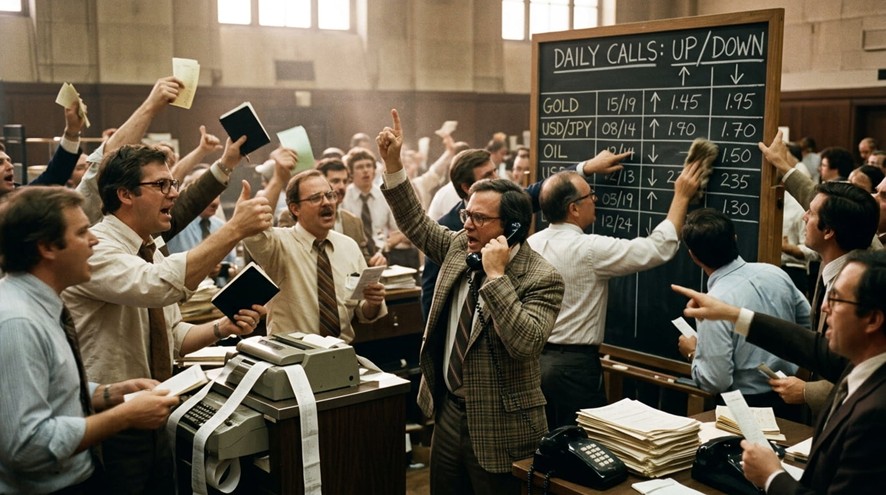
In the late 20th century, investment banks, corporate treasuries, and hedge funds privately used these non-linear contracts to hedge highly specific portfolio risks. Why? Because standard “vanilla” options were not always suitable for these purposes.
The payout on a traditional option grows based on numerous factors (sensitivity coefficients of the option premium, known professionally as option Greeks), but primarily on how far the asset’s price moves into-the-money. But what if you are only interested in a single binary event? What if your balance sheet depends on a precise central bank interest rate decision, the stability of a currency peg, or a corporate debt threshold being breached? This is precisely where digital options come to the rescue.
They allowed financial institutions to secure exact, fixed cash payouts against discrete “yes-or-no” market risks without overpaying for unnecessary price swings. Naturally, pricing these exotic instruments was far from simple guesswork; it required rigorous mathematics. At its core was the theory introduced by economists Fischer Black and Myron Scholes in their seminal 1973 paper on option valuation. Later, financial engineers Mark Rubinstein and Eric Reiner expanded upon it in their influential 1991 study, “Unscrambling the Binary Code.” Their work provided Wall Street with the precise pricing formulas needed to value discrete payouts based on implied volatility (IV) and time decay.
As institutional trading volumes grew, the Options Clearing Corporation (OCC) officially codified the definitions and risk disclosure requirements for standardized exotic options. In doing so, the OCC recognized binary contracts as legitimate, cleared derivatives – a far cry from the unregulated online retail platforms that would emerge decades later.
The birth of exchange-traded binary options in Chicago
Today, it is hard to believe, but binary options did not originate as shady pop-up ads from Caribbean offshore brokers promising quick riches. Their official retail debut took place at the very center of the U.S. financial world: Chicago.
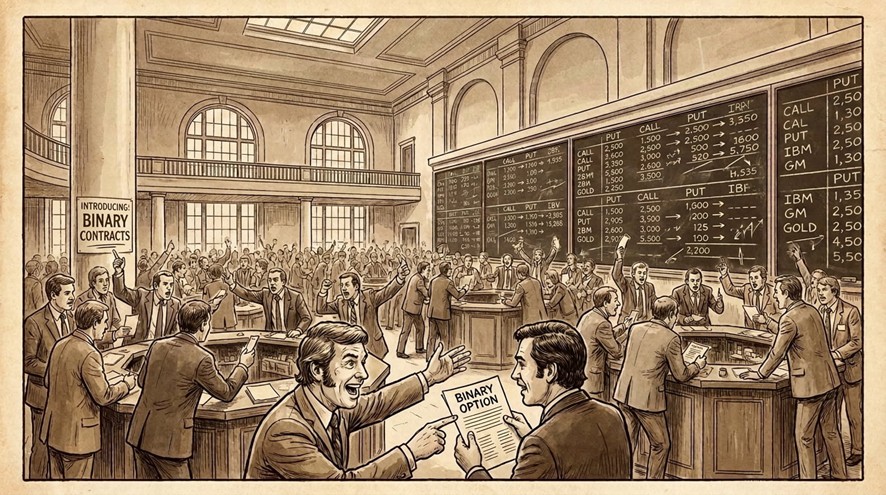
By the mid-2000s, U.S. regulators and exchanges saw opportunities to grow the market through this new instrument. Retail investors needed simple products with clearly defined risk while requiring the safety of a regulated market.
Enter HedgeStreet, an innovative exchange that received approval from the Commodity Futures Trading Commission (CFTC) for event contracts – later renaming itself the North American Derivatives Exchange (Nadex). Shortly after, in May 2008, the Securities and Exchange Commission (SEC) officially approved Fixed Return Options (FROs) on the Chicago Board Options Exchange. Just like that, binary options became fully legal, mainstream, and SEC-approved.
So, how did these exchange-traded binary options actually work? Imagine it as a simple, transparent three-step mechanism: trader -> exchange -> clearinghouse. When you bought a CBOE FRO or Nadex contract, the exchange matched your order with another trader’s order in the open market. The Options Clearing Corporation acted as the central counterparty, guaranteeing all settlements.
The exchange had no stake in whether you won or lost; it simply charged a tiny, transparent commission per transaction. There were no hidden markups, no quotes pulled out of thin air, and the exchange had zero incentive to sabotage your trade. This leads us to one of the greatest ironies in modern financial history: if regulated binary options were so safe, transparent, and fair, why didn’t everyday retail investors flock to them?
As Warren Buffett famously observed, “Wall Street is the only place that people ride to in a Rolls-Royce to get advice from those who take the subway.” Real exchange trading required actual work. On Nadex or CBOE, you had to read an order book, understand bid-ask spreads, and calculate probability metrics.
There were no flashy countdown timers, no “$10,000 free demo bonuses,” and no pushy account managers calling you at 2:00 AM urging you to double down. Transparent financial markets are inherently boring, and boring doesn’t go viral. Unbeknownst to Chicago regulators, offshore operators were already watching, taking notes, and preparing to strip away every single safety feature that made exchange-traded binaries work.
How binary options became available to everyday traders
If Chicago offered a boring, transparent financial product, how on earth did binary options transform into a high-octane global sensation almost overnight?

The answer lies in a classic financial plot twist: offshore operators looked at Chicago’s complex order books, threw out the safety features, and asked a million-dollar question: What if we make trading look like a video game?
Before Cyprus and Tel Aviv turned the industry into a turnkey mass market, BetOnMarkets (later rebranded as Binary.com, and now Deriv) was the true pioneer of retail financial betting. Founded at the turn of the millennium and operating under hybrid gambling and financial licenses from the Isle of Man and Malta, BetOnMarkets introduced retail clients to fixed-odds “financial bets” as early as 2000–2001. The platform proved that everyday internet users were eager to speculate on intraday price swings right from their browser – long before the offshore binary boom took the world by storm.
Around 2010, the epicenter of this transformation shifted to Cyprus. Why Cyprus? It offered an irresistible cocktail: a sunny EU jurisdiction, access to European retail clients under CySEC regulation, and a remarkably lax approach to marketing. Offshore pioneers took the underlying Cash-or-Nothing mathematical formula and stripped away the order books, bid-ask spreads, and clearing houses. They replaced them with two bright, irresistibly simple buttons: Call and Put.
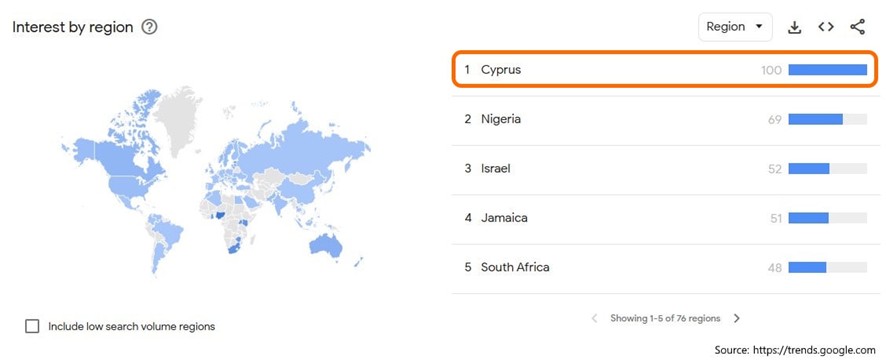
Suddenly, you didn’t need to analyze market depth or read a 50-page prospectus. You just had to guess whether a line on a chart would go up or down in the next sixty seconds.
To supercharge growth the business, operators turned on a massive, aggressive marketing engine. They partnered with vast affiliate networks (CPA and IB models), flooding the internet with targeted ads.
Remember those pop-ups showing a 22-year-old standing next to a leased Lamborghini, claiming he made $5,000 before breakfast? That was the core strategy. Throw in risk-free “deposit bonuses,” and pushy account managers, and you had a recipe for viral addictiveness. As American entertainer and entrepreneur P.T. Barnum famously remarked, “There’s a sucker born every minute.” The new offshore brokers were counting on it.
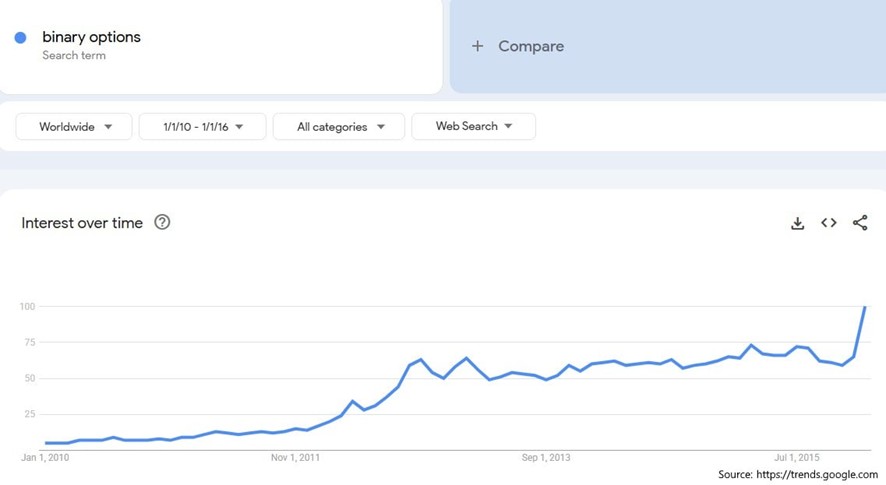
Google Trends data from the era tells the whole story. While searches for regulated exchanges remained flat, queries for retail binary brokers exploded exponentially. The product had officially migrated from the quiet boardrooms of Chicago to the chaotic, unregulated frontiers of the internet.
One of the brokers from that early stage is IQ Option, which was born in 2013, and briefly became extremely popular.
The rise of white-label binary options platforms
Flash back to early 2010. Binary options had not yet become a toxic brand; instead, they represented the “Wild West” of fintech. If you had an idea, a bit of cash, and a desire to launch your own brokerage, you didn’t need to build everything from scratch. You just had to find guys like Tradologic.
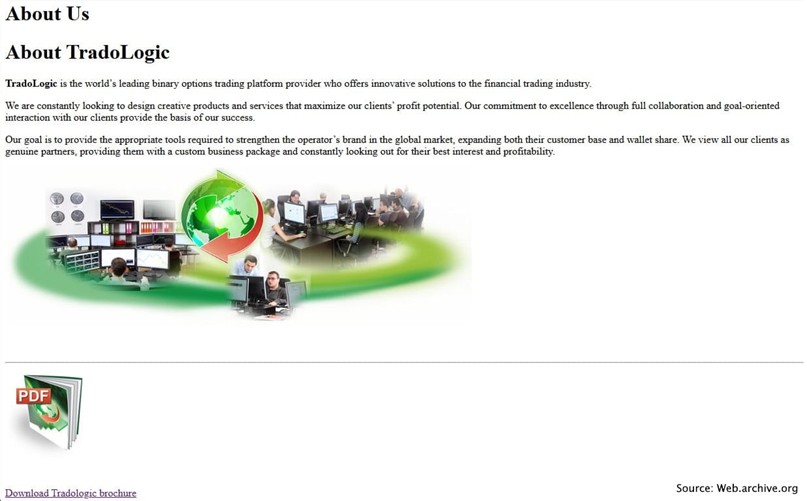
They didn’t merely sell software – they offered a turnkey business that replaced an entire army of lawyers, complex clearing infrastructure, and direct access to global liquidity providers. The phrase “all-inclusive” took on a whole new meaning. Essentially, it described the business model perfectly: anyone could start providing brokerage services in literally a matter of days.
Thanks to White Label solutions, you received a fully packaged website: hosting, customer support, a risk management system, payment processing, and even anti-fraud protection. All that was left for you to do was pick a logo, hire a couple of aggressive marketers, and wait for the deposits to roll in. Convenient? You bet. It was like buying a ready-made cake at the store instead of baking one from scratch.
By the way, did you know that behind all this polish, a complex ecosystem was buzzing? Just take a look at their back office – it was a true command center, not just a control panel. Everything was interconnected. The CRM system tied together sales, marketing, retention, support, finance, and the trading desk. Imagine being able to track in real time who just deposited funds, who is on the verge of leaving, and who needs a bonus promo code sent their way. Armed with this kind of analytics, brokers felt like gods in this digital world.
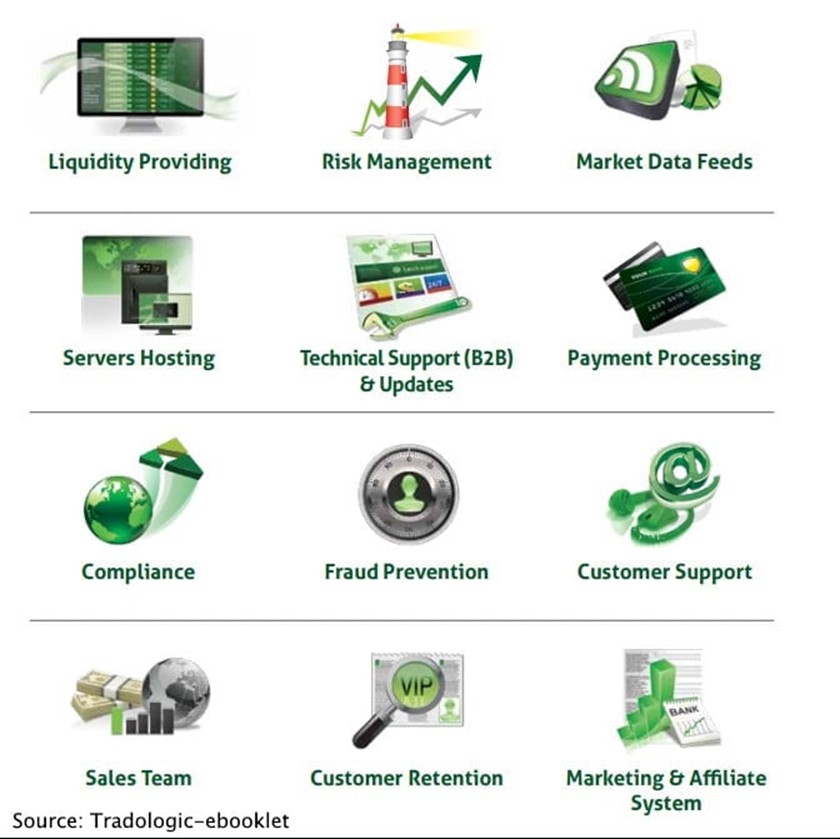
What’s most interesting, however, is how the approach to clients evolved. Where a broker once thought, “Give me a platform,” by 2015, SpotOption decided, “Let’s give them sales tools, too!” They launched the Spot+ update, introducing automated dialers (Autodialer), a client chat and push notification module (Communicator), and mailing list databases (Mailer Database) directly into the platform. With this update, brokers no longer needed to hire an army of call center agents – automation began displacing humans. As then-CEO of SpotOption Ran Amiran put it back then, “sales and marketing play too vital a role not to be included in our solution.” Makes sense, doesn’t it?
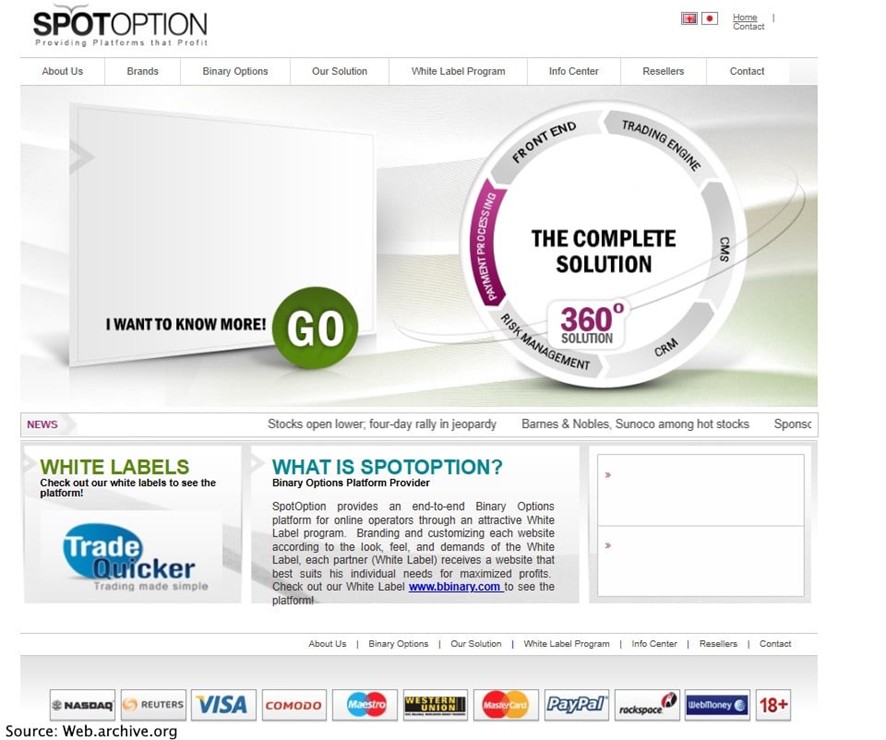
The binary options market responded to this innovation with explosive growth. According to SpotOption, over 250 partner brands were using its platform by 2015. Other companies fueled this growth as well. For instance, PandaTS took a broader white-label approach compared to the standard model: the vendor provided the broker with not just a trading interface, but a significant portion of the business’s operational infrastructure, spanning client acquisition, registration & KYC, deposit processing, trading, risk management, communication, and retention.
However, the story of these companies spans far more than software development and sales scripts. To be precise, it wasn’t just about that – it was about big money and grand ambitions. A prime example is TechFinancials. In 2015, they became the first binary options platform to go public on the London Stock Exchange (AIM). Can you imagine? An entire segment of the “grey” market suddenly became public and respectable.
TechFinancials was not alone; platforms like Tradologic also fueled this gold rush. Brokers of that era, from OptionBit to KingOption, relied on Tradologic’s infrastructure to scale almost overnight. Thanks to this new software, launching a financial brand became as simple as opening a fast-food franchise.
Yet, as is usually the case, there was a flip side to the coin. Regulators burst into this idyll like bulls in a china shop. By 2018–2019, numerous countries had imposed strict bans. Brokerages shut down, and the B2B software providers themselves were forced to pivot.

And do you know the funniest part of this story? TechFinancials – the very company whose name had echoed across the London Stock Exchange – eventually re-emerged as… a mining company that also dealt in blockchain-based football tickets. Unbelievable! Talk about a plot twist: from binary options to diamond mining. The white-label platform market faded into history as a vibrant yet volatile era where anyone could become the owner of their own – albeit very peculiar – brokerage in just a few weeks.
Why so many binary options brokers were based in Israel
Have you ever wondered why Israel – the nation of startups and high tech – suddenly became the global capital of binary options sales? It was no accident, but rather a perfect storm.

At its peak, the binary options industry based in Israel was a literal money-printing machine. Experts estimate its annual turnover was between $5 billion and $10 billion. Hundreds of companies packing skyscrapers across Tel Aviv, Ramat Gan, and Herzliya employed thousands of multilingual staff. Typically, most of them were recent immigrants struggling financially due to the country’s high cost of living.
Finding themselves in a tough spot, most were eager to earn money without inquiring too deeply into what they were actually doing. High commissions did their job. Brokerage employees used aliases, fake local numbers, and VoIP software to call their clients.
The situation was further compounded by the fact that Israel was home to the world’s top developers of B2B software for binary options – such as SpotOption and Tradologic – who created turnkey solutions for brokers. Add elite search engine optimization (SEO) specialists and massive, aggressively managed call centers to the mix, and the industry’s explosive growth became inevitable.
In effect, Israel offered the ideal conditions for this ecosystem to thrive. A glaring loophole in local law allowed newly minted brokerages to sell their services to foreigners while staying completely under the radar of local regulators. As a result, Israeli law enforcement remained oblivious for a long time to the global fraud happening right under their noses.
Yet this was merely the tip of the iceberg – the vast majority, as always, remained submerged. That larger part was the workforce. Between 2010 and 2015, Israel welcomed hundreds of thousands of immigrants fluent in Russian, French, Spanish, Arabic, and English. For many, working in these call centers was their only chance to earn a salary that allowed them to survive Tel Aviv’s astronomical prices.
Surprisingly, many joined firmly believing they were earning an honest living, completely unaware that they were signing up for “economic terrorism” – as one former call center employee vividly put it.
There is no telling how long this would have continued had journalist Simona Weinglass from the local news outlet The Times of Israel not published a series of exposés in 2016. The first of these, sensationally titled “The Wolves of Tel Aviv,” landed with explosive force. This scathing investigation sparked intense international outrage and ignited fierce debates in the Knesset.
 Politicians and the head of the Israel Securities Authority (ISA), Shmuel Hauser, openly branded the industry a “national disgrace” that was inflicting immense reputational damage on the country internationally. Lawmakers noted with alarm that foreign diplomats were incessantly lodging complaints about Israeli call centers draining the savings of retirees, truck drivers, and vulnerable citizens across Europe and North America.
Yet even that was not the most shocking revelation. During a Knesset hearing, a statement was made that made politicians’ hair stand on end. Israeli Police representative Gabi Biton stated that behind binary options stood not just rogue marketers, but the leadership of criminal syndicates. Indeed, organized crime was flexing its muscles on the backs of gullible retirees around the world. According to him, the scope of evil had grown to truly “monstrous proportions.”
Ultimately, on October 23, 2017, facing mounting international pressure and damning reports from law enforcement and investigative bodies, the Knesset unanimously passed Amendment No. 63 to Israel’s Securities Law by a vote of 53 to 0. This law didn’t just ban soliciting retail traders; Article 44A1 explicitly criminalized providing B2B software, marketing, or call center services to any binary options firms worldwide, carrying penalties of up to two years’ imprisonment.
While people had previously viewed it as just business, anyone attempting a similar operation from Israeli territory now faced real prison time. Just like that, the empire was officially outlawed. Yet while binary options operators were winding down their call centers, many simply tweaked their software, shifted their B2B operations offshore, or pivoted entirely to new ventures.
Inside the binary options sales machine
Imagine you are an average internet user looking to make a little extra money on the side. You type into Google: “making money on binary options” or “broker X reviews.” What will you see? Instead of a regulatory warning, dozens of websites will appear, styled as independent ranking platforms detailing why you should open an account with Broker X rather than Broker Y. But as always, the devil is in the details.
SEO specialist Yoni S. and cybersecurity expert Brian Seely believe the binary options industry learned to manipulate search engine results. Companies bought up review sites en masse, clogging search engines and passing scammers off as honest brokers. National regulators simply lacked the promotional budgets to push risk warnings the way the scammers did – and lost that battle hands down.
This system for promoting pseudo-brokers became so efficient that Israel effectively turned into a global exporter of illicit B2B financial infrastructure. Executives hosted international training sessions, selling turnkey software packages, call center scripts, and operational models to incoming foreign delegations – from British-accented businessmen to European partners – spreading this “virus” worldwide.
Now let’s step inside the business. How exactly did they process clients? They operated a well-oiled, two-stage system:
Stage 1: the conversion department
First-line operators were tasked with securing the initial deposit, typically $200 to $250. At this stage, sales managers painted pictures of the benefits of private trading and the dream of financial freedom.
Everything was fair game: from banal ads for miracle trading bots promising incredible returns and “safe starter packages,” to outright lies featuring fabricated biographies and psychological pressure. The work environment added its own distinct twist. Salespeople typically worked out of a large room crammed with desks, monitors, and cheap, internet-connected rigs – the owners saved money even on computers.
Using Voice over IP (VoIP) software, these call centers spoofed local phone codes, convincing victims in London, Toronto, or Sydney that their broker was calling from a local financial district rather than a skyscraper outside Tel Aviv.
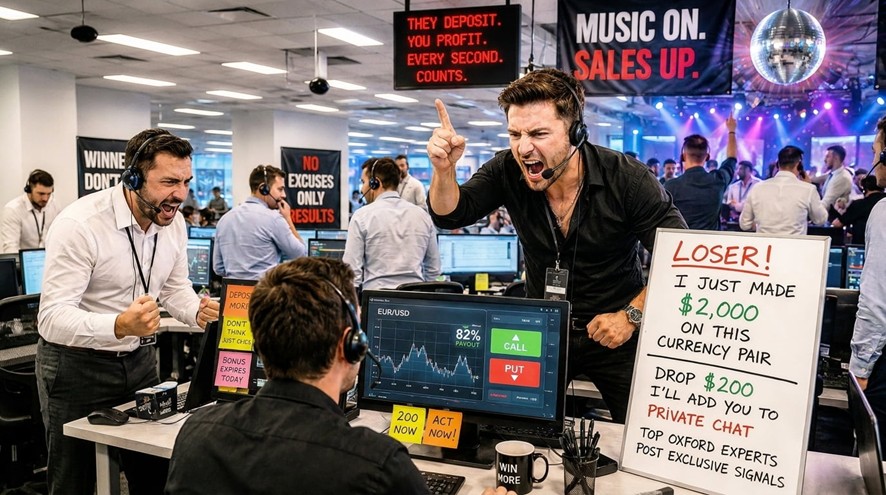
Now imagine rows of managers standing (sitting was strictly forbidden!) shouting into cheap headsets: “Hey, you loser, I just made $2,000 on this currency pair while you’re still living off your parents! If you want in, all you need to do is drop a measly $200, and I’ll add you to our private chat where top Oxford experts post exclusive signals for us.”
Music added a unique flavor to the floor. It’s unclear where the trend originated, but senior managers firmly believed that standing up and listening to music made their subordinates sell better. Over time, this backfired. Upon hearing a familiar tune through the receiver, clients would launch into furious rants, vow to track the caller down, and slam the phone down. But that came later.
In the meantime, if they managed to fool a bus driver or mechanic from Europe or the US, managers from another department stepped in.
Stage 2: the retention department
This was where true psychological warfare began. If the first-stage specialist (known internally as a “converter”) sold you a “trading bot” or access to a “millionaires’ club,” the retention agent sold you a “personal analyst.”
Retention staff earned massive commissions and held back nothing. For instance, while you shared your screen “to inspect and configure the trading platform,” the call center employee was instructed to search your computer for adult files or signs of a gambling addiction.
If they uncovered an addiction, it was a clear signal: “the client is hooked; squeeze them for everything.” Next, they would open Google Maps to search for the victim’s address, sizing up their financial standing. Then came the pressure: “If you can’t put in $5,000 to $10,000, you’re just not serious” (usually expressed in far harsher terms).
Additionally, these “managers” didn’t hesitate to pry into payment card details, checking statuses to see how much money was left. If you asked to withdraw funds, they would immediately pitch “bonuses.” The catch was that these bonuses required astronomical trading volumes – typically 30 to 40 times the bonus amount. In practice, this turned into an endless trap from which clients walked away penniless.
Finally came the worst part. If you managed to resist and demanded your money back, agents were instructed to simply block you on Skype (which was still widely used back then), stop answering calls, or accuse you of money laundering. Later, they used the line “unauthorized use of third-party software” – even though those same managers had offered to let you test their “profitable bot” at the start of your “collaboration.”
Welcome to the casino, where the house always holds the wheel.
A clear technical architecture underpinned the entire operation. Trading platforms were equipped with administrative backdoors and risk control settings. As revealed in federal court documents against the provider SpotOption, if a client went on a winning streak, the dealing room could manually adjust the account’s risk settings – introducing execution delays, altering price feeds, or manipulating last-second expiry quotes to guarantee the house won.
It was a rigged game from start to finish. The client was never trading on an open market; they were playing against a dealer who controlled the odds, the rules, and the exit doors.
How investment expos helped sell the binary options dream
Did you really think an industry turning over up to $10 billion a year would stay hidden in the dark corners of the internet? Far from it. At its absolute peak between 2012 and 2016, the retail binary options machine didn’t just step into the light; it practically took over the world’s biggest financial trade shows, throwing lavish parties and operating completely out in the open.
If you had walked onto the exhibition floor of an iFX EXPO in Cyprus or Hong Kong during those golden years, you wouldn’t have seen shady operations. You would have seen massive, neon-lit B2B booths hosted by software giants like SpotOption, Tradologic, and TechFinancials.They weren’t there to sell binary options to retail traders; they were selling the turnkey infrastructure to anyone who wanted to become a broker overnight. Experienced B2B teams openly pitched full-service packages: “You bring the marketing budget, and we’ll provide the trading engine, the CRM, the call-center scripts, and the payment gateways!”

In effect, Israeli executives openly used such events as an international hub for acquiring foreign clients – from the British Isles to the Asia-Pacific region – teaching them everything they themselves did so well: how to build and operate binary options “factories.” Israel was not merely establishing call centers on home turf; it was exporting this model for capturing the retail financial market worldwide.
Meanwhile, at major digital marketing conferences like the Affiliate Summit and Conversion Conference, the binary options industry was the undisputed cash cow. Specialized affiliate networks (operating under CPA and IB models) bought up prime exhibition space, bidding absurd prices for user traffic. Brokers paid sky-high commissions – hundreds of dollars for a single initial deposit of $250 was completely routine. Naturally, this lured hordes of affiliate marketers, SEO specialists, and media buyers to generate new leads.
Then came a sudden and dramatic disappearance.
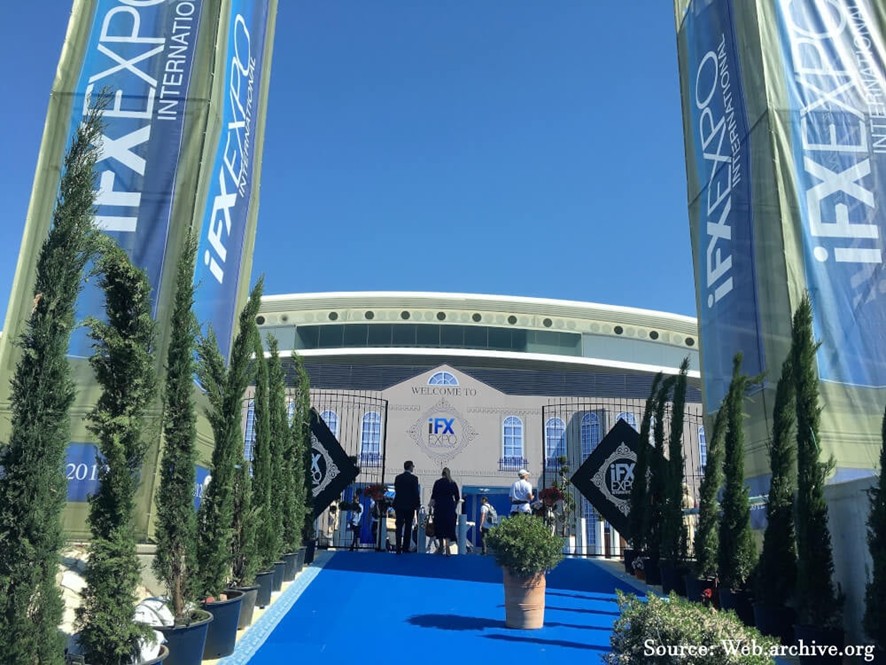
By the time iFX EXPO International 2017 opened in Limassol, industry journalists observed a stark contrast. As media reports exposed call center fraud and regulatory bodies such as the SEC, ESMA, and ISA cracked down hard, the presence of binary options representatives did not merely dwindle – it vanished entirely. There were no booths dedicated to the financial instrument, no branded trinkets, and not a single mention of the product during panel discussions. Binary options transformed from a dominant force on the floor of global expos into an absolute taboo – as though these multi-million-dollar B2B empires had never existed at all.
Behind binary options platform manipulation
If you have ever been to a casino, you have likely thought that the game was rigged. Yet to all your doubts, the staff would always reply: “That’s just how the odds work.” In the world of offshore binary options trading, this nagging suspicion was not paranoia, but standard practice. Beyond aggressive promotional tactics and unrealistic promises, platform owners resorted to an entire array of technical abuses and software manipulations to guarantee that the house always won – no matter how meticulously a trader analyzed their charts.

Rigging the game
When traders logged into a system provided by a white-label vendor like SpotOption, they believed they were seeing independent, real-time global market quotes. In reality, the dealing desk possessed absolute control over everything displayed on the screen.
According to documents filed with the Securities and Exchange Commission (SEC) and records from federal criminal cases, platform providers allowed brokers to classify accounts into risk tiers: “low,” “medium,” or “high.” If an investor started winning consistently on assets like EUR/USD or gold, the broker didn’t celebrate their success; instead, they sent an urgent request to the platform’s risk management department. Internal emails seized by law enforcement reveal brokers asking platform providers to “check the risk and make adjustments to ensure stability,” or to reclassify profitable clients as “high risk.”
Once an account was flagged, the software automatically rigged the outcomes. Platforms introduced imperceptible execution delays (requotes), generated artificial quotes, or subtly altered expiry rates in the final seconds of a trade to turn a profitable option contract into a loss. If an asset behaved too predictably – such as when copper prices surged following a major earthquake in Chile – brokers simply removed the asset from the platform entirely or retroactively voided profitable trades, relying on fine-print clauses that claimed their internal algorithms were not required to match real-time market conditions.
Locked accounts and forced trading
If a client was clever and attempted to bypass the system by trading cautiously or temporarily stepping away, the platform had specific mechanisms ready for that scenario as well.
Brokers regularly imposed account restrictions to keep traders active. If a client stopped making trades, brokers enforced hidden rules – such as requiring a mandatory minimum number of trades every 30 days simply to keep the account active or to ensure access to funds.
Far worse was the tactic involving bogus “client exposure.” It worked like this: when an account manager sensed that an investor was preparing to request a withdrawal, they would execute unauthorized, long-term trades directly on the client’s account. Broker representatives would then tell the victim that their funds were locked in open positions and could not be touched until those long-term options expired – buying the company enough time to drain the remaining balance.
Withdrawal verification abuse
For those few traders who somehow managed to turn a profit and requested a payout, the withdrawal verification process became the final hurdle.
Brokers used Anti-Money Laundering (AML) and Know Your Customer (KYC) regulations not as legal protections, but as a deliberate stalling tactic. As soon as a withdrawal request came in, the finance department would demand an endless stream of documentation: utility bills, notarized copies of IDs, credit card scans, and bank statements.
While the client was gathering documents, retention agents called relentlessly, trying to persuade them to execute “just one more big trade.” If the client held firm, the platforms resorted to flimsy excuses – claiming the account was “under review by the legal department,” falsely accusing the trader of fraud or money laundering, or simply ignoring emails and locking the account entirely.
This system was never designed to be an open financial market. From artificial execution delays to back-end quote manipulation, every technical feature served a single purpose: to keep client deposits on the platform forever.
From bucket shops to offshore binary options brokers
You know, in the world of finance, very little actually changes. Technologies have advanced from paper ticker tapes to HTML5 web charts, but the essence of fraud in this space remains the same. To understand binary options, you don’t need to be a programmer – you just need to read Edwin Lefèvre’s 1923 book, “Reminiscences of a Stock Operator.” It contains a striking parallel to what we witnessed just a few years ago.
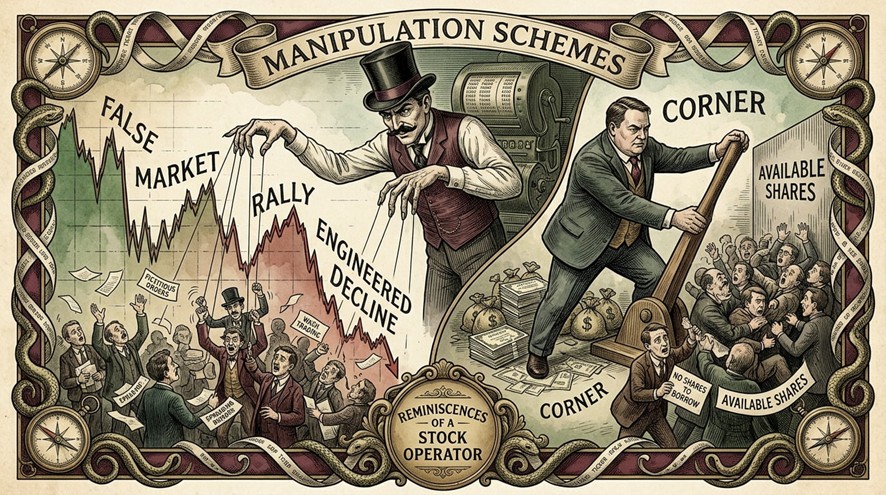
Let’s step back in time to the United States of the early 20th century. The book’s main character, Larry Livingston (a fictionalized version of real-life trader Jesse Livermore), starts his journey in so-called “bucket shops.” These were cheap establishments where clients bet on stock price movements. Anyone could walk in, hand over cash, glance at the ticker tape, and bet on whether their favorite stock would go up or down. That was it.
Your order never hit the real New York Stock Exchange. You were playing against the house itself, which acted as both your bookmaker and your casino. Binary options operate on the exact same principle: you click the “Call” or “Put” button on a slick website interface thinking you are entering the global market, when in reality your order disappears into the “black box” of SpotOption or Panda servers. The counterparty to your trade is the dealer running the firm where you opened your account. Edwin Lefèvre’s Larry Livingston called this “playing the fluctuations.” Its essence is simple: you aren’t betting on the market, but on whatever that black box chooses to show you.
Yet the most interesting part lies in the methods of manipulation.
| Manipulation Technique | The 1900s Bucket Shop | The 2010s Binary Broker |
|---|---|---|
| Price Feed Control | Intentionally delaying or misreporting ticker tape numbers to wipe out narrow margins. | Using dealer consoles, platform dealers create synthetic spreads, filter quotes, and generate requotes. |
| Execution Delays | Clerks slowed down ticket marking until an artificial market dip wiped out the trader. | Software algorithms that create artificial execution delays of 3–5 seconds when a trade expires. |
| Targeting Winners | “Bucket-shop drives” – washing prices on the NYSE to deliberately trigger stops and wipe out winning clients. | Flagging profitable accounts as “high risk” in the CRM to automatically degrade trade execution. |
Centuries-old bucket shops used simple schemes: they delayed ticker tape feeds so the client saw outdated prices, or squeezed local volume to trigger stop-losses. And when a client won, they were simply asked to leave the premises. Today, 100 years later, the arsenal has become technically far more sophisticated, but the goal remains unchanged. The dealing consoles of modern brokers allow them to do the exact same things – from execution delays to requotes and real-time quote filtering. As Lefèvre wrote: “The funny thing was that ten days after Cosmopolitan tried to trick me, a New York operator cheated them out of over seventy thousand dollars.” They fell into a similar trap set by another dealer.
The main takeaway from this historical retrospective is very simple. Larry Livingston made fortunes in these bucket shops because he learned to read the tape faster than their owners could manipulate the prices. But for an average person looking at a slick chart on a screen, this game is merely a one-way ticket. The business model of an unlicensed over-the-counter casino hasn’t changed a single iota in a hundred years. As the book’s protagonist famously said, “The market does not beat them. They beat themselves.” The data transmission technology has changed, but the underlying essence has not.
Why the odds were heavily stacked against binary options traders
To justify the endless losses suffered by retail binary options traders, brokers devised a convenient excuse: “You simply misjudged the direction of the market.” Was that truly the case, or did the losing streak stem from causes far more fundamental than poor technical analysis?
To answer this question, we must divide the causes of retail trader losses into two components: blatant fraud on the part of bad-actor platforms, and the underlying mathematical reality of the payout model.
The problem was that even on a squeaky-clean platform – one that never manipulated quotes or blocked withdrawals – the mathematical odds were heavily stacked against the trader. Because a losing trade resulted in a 100% loss while a winning one yielded only a 70–80% return, staying profitable demanded an exceptionally high edge and win rate just to break even.
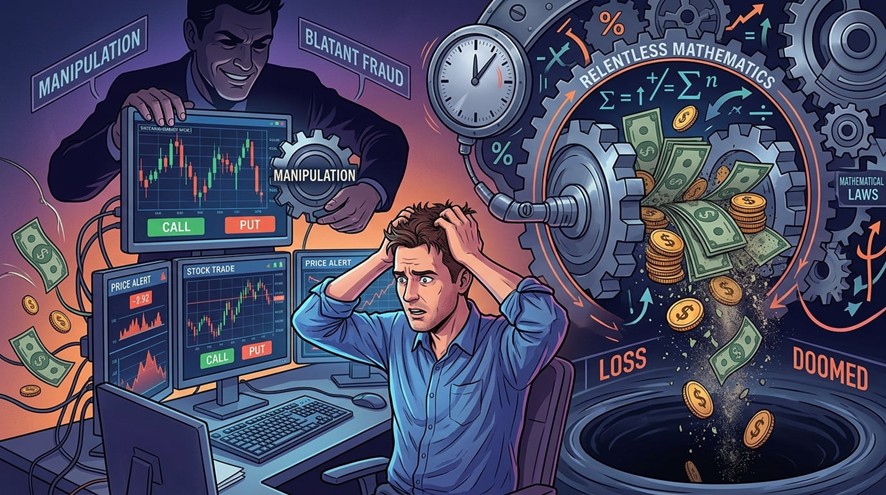
The product itself was designed so that over time, you would lose every last cent.
Two ways to lose: manipulation or the math
To grasp the root of the problem, we must briefly delve into academic territory and divide the causes of trader losses into two categories:
- Malicious interference in client trading by platform owners: as documented in SEC and CFTC filings, these include software-side quote manipulation, artificial price gaps, execution delays, and “bonus” lock-ins designed to prevent withdrawals.
- The platform’s structural mathematical edge over traders: as established in risk management standards at the Options Clearing Corporation (OCC) and in the binary option pricing literature by Rubinstein and Reiner (1991), a binary contract is a rigid, discrete “all-or-nothing” bet.
While the first layer describes criminal conduct by binary options operators, the second layer represents the pure financial architecture of the product itself. Even without a rogue dealer, the math alone creates an inescapable statistical trap into which every binary options trader falls.
The math of losing: how negative expected value works
In 1991, Mark Rubinstein and Eric Reiner officially codified the mathematical model for digital (or binary) options in their paper “Unscrambling the Binary Code.” They laid out the pure math: if the asset price crosses the option contract’s strike, the trader receives a fixed payout; if it doesn’t, they get nothing. Equations, Gaussian distributions, logarithmic random walks – sheer beauty!
In theory, that is. In practice, it is far more sinister. On regulated exchanges like CBOE or Nadex, binary options serve as a hedging tool where traders can secure fair market pricing. But in offshore bucket shops, where platforms like SpotOption and Tradologic offered a 70–80% payout against a 100% loss risk, it was a broad daylight robbery. Imagine playing roulette where a bet on red pays 80 cents, a bet on black costs you a whole dollar, and the wheel itself is being spun in the next room!
This is where negative expected value enters the equation. Suppose you bet $100 that the price will rise. If you guess correctly, you get $180 (your initial $100 plus $80 profit). If you guess wrong, you lose the entire hundred bucks. Consequently, just to break even, you need to win more than 55% of all your trades. And when the broker actively “filters” quotes on the dealing console, your chances of success plummet to those of a lottery ticket.
Over a handful of trades, you might get lucky. But across hundreds of micro-expiry trades, the Law of Large Numbers relentlessly takes effect. Your account balance will inevitably trend toward zero.
The illusion of control: the trap of constant trading
In “Reminiscences of a Stock Operator,” Edwin Lefèvre issued a famous warning about the obsession with non-stop trading: “There is the plain fool, who does the wrong thing at all times everywhere, but there is the Wall Street fool, who thinks he must trade all the time.”
Retail binary options platforms were deliberately engineered to exploit this psychological flaw. By pairing 60-second “turbo options” with negative expected value, brokers created a high-speed feedback loop. Traders failed not because of a lack of intelligence, but because they were playing a game where the mathematical odds were stacked against them before the chart even moved a single pixel.
The global crackdown on binary options
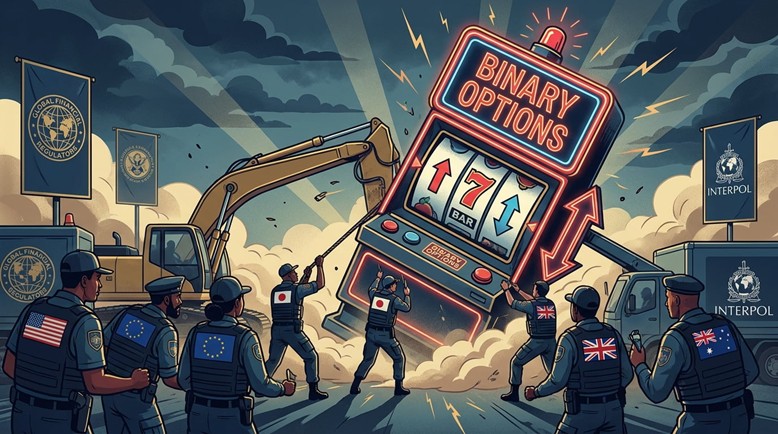
When financial regulators around the world realized that retail binary options resembled illegal casinos far more than capital markets, their response was swift and relentless. What began as isolated civil lawsuits rapidly escalated into a coordinated, pan-European, and intercontinental ban.
US regulators strike first
The United States led the initial offensive. The Securities and Exchange Commission (SEC) and the Commodity Futures Trading Commission (CFTC) were the first to sense trouble, targeting non-compliant offshore platforms that solicited US citizens to trade financial instruments without proper exchange registration.
In 2013, federal regulators filed landmark lawsuits against the Cypriot giant Banc de Binary, forcing the company to pay a massive $9 million in restitution and penalties. Later, civil charges were also brought against software infrastructure provider SpotOption (Spot Tech House) for facilitating a $100 million fraudulent scheme. Rather than fighting an endless war against local brokers, US authorities aimed directly at the B2B platform providers, nipping the spread of this scam technology in the bud.
Israel delivers a unanimous blow
While the US struck from the outside, the beating heart of the binary options industry in Israel was bombarded from within. Fueled by investigative exposés published in The Times of Israel, public outrage forced the Knesset to act.
On October 23, 2017, Israeli lawmakers passed Amendment No. 63 to the Securities Law by a vote of 53 to 0. Article 44A1 went beyond banning the sale of binary options to local citizens – it explicitly criminalized the provision of B2B software, marketing, or call center services to any binary options operator worldwide, carrying penalties of up to two years’ imprisonment.
Shmuel Hauser, head of the Israel Securities Authority (ISA), called the industry a “national disgrace,” dismantling the multi-billion-dollar binary options sector overnight.
Belgium and France lead the European crackdown
Long before ESMA acted continent-wide, two EU member states took matters into their own hands:
- Belgium (FSMA): In July 2016, Belgium became the first EU country to enact a full ban on the distribution of retail OTC derivatives and binary options, effectively outlawing cold calls from call centers and aggressive B2C sales tactics in the region.
- France (AMF): Under the landmark “Loi Sapin II” (Law No. 2016-1691), passed in late 2016, French regulators banned all direct and indirect digital advertising, sports sponsorships, and pop-up ads related to binary options and speculative Forex products.
Europe closes the door on retail binary options
Events in Europe unfolded just as rapidly. The European Securities and Markets Authority (ESMA) invoked its product intervention powers under Article 40 of Regulation (EU) No 600/2014 (MiFIR).
As a result, starting in 2018, ESMA enacted a complete ban on the marketing, distribution, or sale of binary options to all retail clients across the EU. National regulators quickly made these temporary measures permanent.
CySEC, the Cypriot regulator long criticized as a lenient tax haven for brokers, was forced to fall in line with the pan-European regulator. It issued strict circulars prohibiting trading bonuses, client referral incentives, and cash rebates, while revoking the licenses of non-compliant firms.
The UK FCA reclassifies the gamble
The UK’s Financial Conduct Authority (FCA) took a structural approach. In 2019, under Policy Statement PS19/18, the FCA permanently banned retail binary options. Crucially, the UK closed a regulatory loophole pioneered two decades earlier by platforms like BetOnMarkets, removing the instrument from the jurisdiction of gambling regulators (where operators had historically hidden behind gambling licenses) and reclassifying it strictly as a financial product before banning it for retail clients altogether.
Canada and Australia close the net
The final blow came from regulators in North America and the Asia-Pacific region, who closed remaining loopholes by categorizing binary options not as legitimate trading tools, but as destructive gambling mechanisms:
- Canada (CSA): On September 28, 2017, the Canadian Securities Administrators (CSA) implemented Multilateral Instrument 91-102 (Prohibition of Binary Options). The rule explicitly made it illegal to advertise, offer, or sell binary options with a maturity period of less than 30 days to individuals. In its accompanying Companion Policy 91-102, the CSA noted that regardless of the terms used by brokers – whether “all-or-nothing,” “asset-or-nothing,” “one-touch,” or “digital options” – they were all “all-or-nothing” wagers offering zero economic or hedging utility, engineered solely as a fraud tool.
- Australia (ASIC): Following years of research showing that 80% of retail clients trading binary options lost money (with net losses topping $490 million in 2018 alone), the Australian Securities and Investments Commission (ASIC) issued the ASIC Corporations (Product Intervention Order– Binary Options) Instrument 2021/240. Taking effect on May 3, 2021, the order prohibited the issue and distribution of OTC binary options to retail clients. ASIC stated that binary options feature an all-or-nothing payout structure, negative expected returns, and extremely short expiry times (often under six minutes), making them fundamentally incompatible with investing or risk management. The ban was later extended through October 1, 2031, completing a global regulatory net.
In less than a decade, a multi-billion-dollar global industry was outlawed through an unprecedented wave of international regulatory alignment.
Why the binary options industry collapsed
Now it is time to discuss why a global, multi-billion-dollar industry collapsed so rapidly. It did not happen because traders around the world suddenly realized the futility of trading binary options due to negative expected value. The collapse occurred because of a total blackout of the trading platforms’ infrastructure across the globe. When a full-scale war is waged against you on every front, running a business becomes problematic – let alone building a successful one.
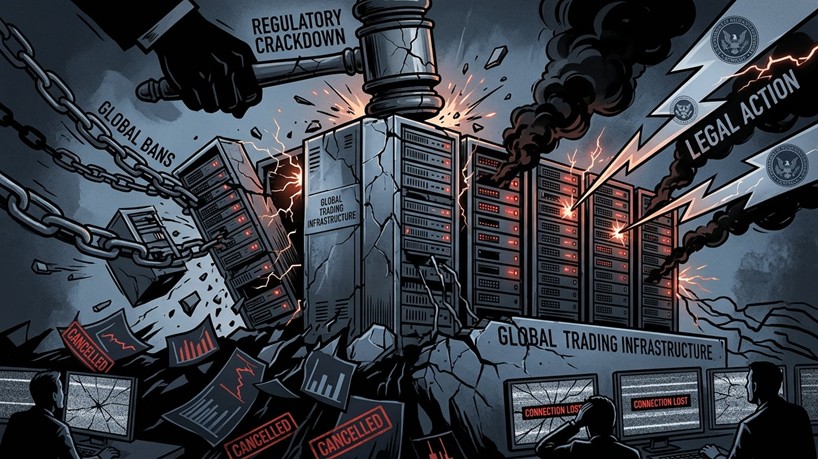
The marketing blackout cuts off the digital pipeline
For years, paid social media advertising served as the primary client acquisition channel for offshore brokers. This was exploited not so much by the brokers themselves, but by a vast army of affiliate marketers hungry for the high commissions so generously paid by binary options platform owners. Affiliate networks also facilitated aggressive client onboarding through ad campaigns, giving hundreds of thousands of digital entrepreneurs worldwide the opportunity to profit from driving traffic to a dubious business.
This business flourished until January 31, 2018, when FB introduced radical changes to its Facebook Ads Policy, banning all ads for binary options, ICOs, and other shady financial schemes – a restriction that extended to Instagram and the Audience Network as well. Google followed suit, updating its advertising policy on March 14, 2018. Effective June of that year, Google Ads banned advertisements for binary options, brokers offering the instrument, trading signals, software, and any informational or educational sites dedicated to these products. Tech titan Microsoft joined in too: as of May 14, 2018, advertising unregulated binary options and cryptocurrency on Bing Ads became impossible.
Virtually overnight, the marketing pipeline supplying a steady stream of thousands of clients to call centers completely dried up. It is remarkably difficult to sell a product you cannot advertise, marking the beginning of the end for this market.
Payment networks cut off the money flow
Losing the ability to market their operations across major ad networks was merely the start of the brokers’ troubles. Following the drop in new client leads, brokers could no longer process credit card payments.
Even if an operator managed to bypass restrictions and lure in a client through clever workarounds, payment systems blocked any transfer addressed to the broker. This severely frustrated platform owners, as it made receiving client funds impossible.
Mastercard’s Business Risk Assessment and Mitigation (BRAM) program became a living nightmare for binary options operators. Its rules directly linked binary options to illegal and high-risk activity. Receiving client payments under these conditions was out of the question; all a broker could expect was the immediate termination of its merchant agreement and placement on the global MATCH (Member Alert to Control High-Risk Merchants) blacklist, also known as the TMF (Terminated Merchant File).
Visa was not far behind its competitor, designating binary options and similar products, including rolling spot forex, spread betting, and CFDs, as high-risk transactions in October 2018.
Payment networks went even further, requiring acquiring banks to demand Tier 1 regulatory licenses before processing transactions. Finding a bank or payment processor willing to work with a binary options platform became practically impossible.
Simultaneously, card networks tightened chargeback dispute rules. Mastercard introduced strict thresholds under its Excessive Chargeback Program (ECP), imposing fines on acquirers of up to $1,000 per violation if a merchant’s chargeback ratio exceeded 1%. This was the death blow to the market. Binary options platforms routinely froze withdrawals or manipulated price quotes, leading furious clients to dispute their credit card transactions rather than writing angry emails.
To initiate a dispute regarding non-delivery of services or unauthorized transactions, issuing banks utilized relevant Mastercard reason codes, specifically 4853 (Cardholder Dispute) and 4837 (No Cardholder Authorization).
For platforms, this was a catastrophe. Once a broker’s chargeback ratio breached the ECP threshold (roughly 1% of transaction volume or 100+ disputes per month), fines kicked in. Losing $1,000 per chargeback was hardly what operators envisioned when setting up an offshore brokerage.
Banks cut off the final escape routes
When Mastercard and Visa processors stopped handling transactions for binary options brokers, operators attempted to route client funds through third-party wire transfers and shell companies. The trick failed. International payment service providers (PSPs) and correspondent banks were unwilling to face massive fines for anti-money laundering (AML) compliance violations and tightened their internal controls. Visa, for example, mandated that acquiring banks perform enhanced due diligence (strict KYC/AML) on merchants – a bar 99% of unlicensed offshore brokers could not pass.
Consequently, banks froze merchant accounts and refused wire transfers. The situation deteriorated further following a series of high-profile investigative reports and criminal indictments launched by the FBI and the US Department of Justice. Against this backdrop, client inflow evaporated as the public realized offshore binary options were an electronic form of an illegal casino rather than a legitimate financial instrument.
Under these conditions, the binary options industry collapsed. No entity, from ad platforms to law enforcement, wanted to be left exposed in such a sweeping international crackdown. Deprived of advertising, cut off from banking, and outlawed worldwide, the binary options industry stood no chance.
To be sure, the embers of this ruin still flicker. Some platform owners relocated to the African continent, hiding behind cryptocurrency anonymity to continue their trade. But the scale is gone, and the stench of a cheap scam follows operators wherever they go. Either way, the golden age is over.
Where binary options went next
Even after being outlawed in most jurisdictions, the multi-billion-dollar binary options industry could not simply vanish overnight. Platform owners were unwilling to part with such a lucrative business. Many of them changed their corporate domicile and relocated to places where their activities would not be subject to the watchful eye of global regulators.
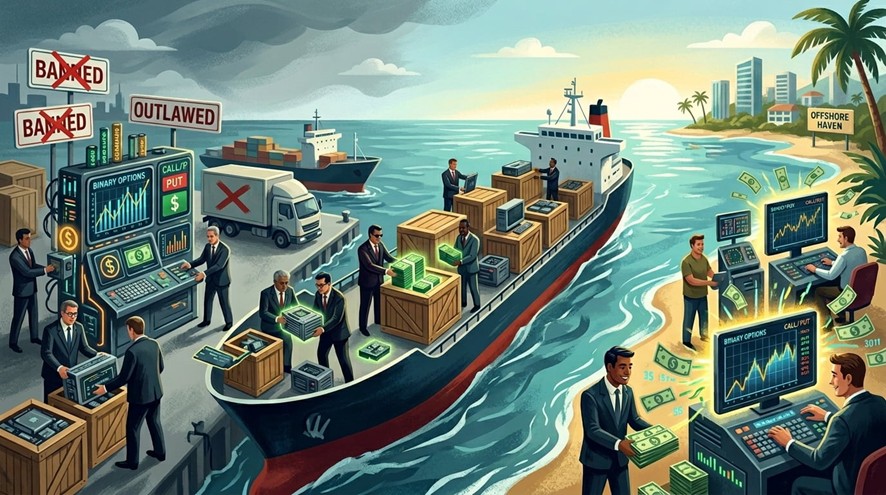
The flight to offshore jurisdictions
As binary options bans spread across the globe, brokers began migrating to exotic jurisdictions few had ever heard of. At the time of writing this review, preferred destinations for operators in this market include Saint Vincent and the Grenadines, the Marshall Islands, Vanuatu, Mwali (Comoros), and Costa Rica.
These jurisdictions were not chosen by chance. They all feature minimal corporate oversight, cheap and – above all – fast corporate incorporation, and a total absence of regulatory monitoring over the local financial market. This lack of restriction allows brokers to bypass strict European and North American rules regarding negative balance protection, leverage limits, and risk disclosure requirements for trading operations.
Offshore traders lose regulatory protection
For everyday clients of such trading platforms, this offshore migration meant only one thing: a complete loss of protection for their interests. First and foremost, this pertained to the absence of segregated accounts, which are designed to keep broker operational funds separate from client capital. Offshore binary options brokers routinely co-mingled client deposits with company capital, enabling them to cover ongoing operational costs for marketing and vendor payouts using client funds rather than their own – a form of interest-free loan that often never gets repaid.
If a broker manipulates price quotes or refuses a withdrawal request, you have nowhere to lodge a complaint. Local island “regulators” do not arbitrate international commercial disputes, leaving aggrieved parties without legal recourse or financial compensation.
It could hardly be otherwise. Unlike regulated markets where compensation is mandated by law (such as the UK’s Financial Services Compensation Scheme – FSCS, or the EU’s Investor Compensation Schemes Directive), offshore zones offer no such guarantees. For the average trader, this means that if their binary options broker goes bankrupt, it will likely simply vanish into thin air along with their funds.
The industry moves into unregulated territories
After the Knesset unanimously voted in October 2017 to ban binary options in Israel, hundreds of experienced call center managers, affiliate marketing partners, and software developers were faced with a difficult choice: shut down their businesses or radically change their line of work.
Some fintech solution developers relocated their offices, opening new call centers in Cyprus, Ukraine, Georgia, and Eastern Europe. Labor costs are low in these countries, and it was easy for platform owners to hire local staff, many of whom speak several languages. The new employees made calls to retail customers across Europe, Asia, and Latin America.
Others refocused their aggressive sales funnels and software architecture on related, highly profitable, and unregulated sectors. This primarily involved initial coin offerings (ICOs) and cryptocurrencies.
In essence, the cryptocurrency boom of 2017–2018 was a natural extension of the activities of former binary options platform operators.
Software providers and CPA affiliate networks shifted their focus from promoting 60-second turbo options to launching speculative token sales, unregulated cryptocurrency exchanges, and high-leverage cryptocurrency margin trading platforms.
Another subset applied its predatory retention tactics to payday micro-lending, diamond trading schemes, and obscure firms offering Forex/CFD trading.
As traditional binary options faded from the financial landscape, the underlying sales engine simply rebranded the product it was pushing. After all, in the world of boiler rooms, the product may change, but the supply of gullible marks never runs dry.
Some brokers, like Deriv and IQ Option created separate entities for EU traders (with CFD trading and no binary options), keeping them registered either in Cyprus or in Malta, while continuing their binary trading business via offshore companies.
How to spot a legitimate binary options broker
Even though the majority of offshore binary options platforms function as unregulated, zero-sum betting shops, a small number of regulated platforms do exist. Distinguishing a genuine, regulated broker from scammers requires thorough due diligence.
Below is a practical, step-by-step checklist to help you evaluate the legitimacy of a binary options broker before depositing funds.
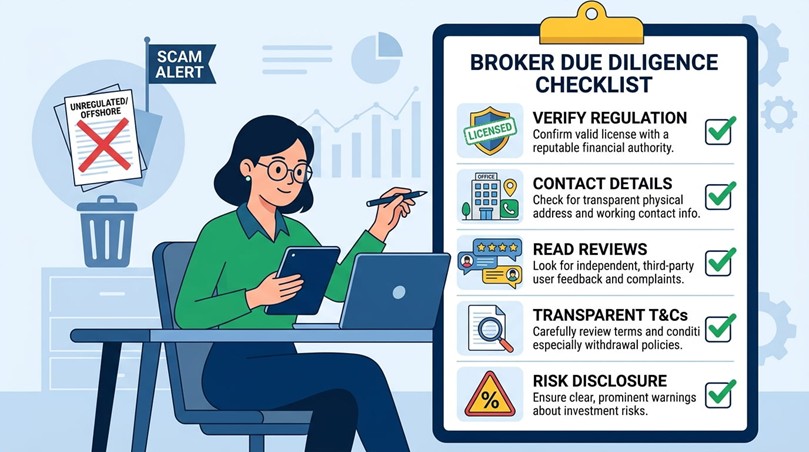
Broker verification checklist
1. Verify Tier-1 regulatory licenses
Offshore brokers often provide false information, including license numbers that do not exist or have long since expired, counting on clients not to double-check them. Many of them do not have any registration documents at all. Verify the exact name of the legal entity and its registration number in the official databases of regulatory agencies (CFTC/SEC, FCA, or ASIC). Legitimate platforms execute trades on exchanges (such as the CDNA or CBOE in the U.S.), rather than through dubious offshore organizations.
2. Verify segregated client accounts and banking details
By law, legitimate brokers are required to hold client capital in segregated accounts at reputable Tier-1 financial institutions, completely separate from the firm’s operational funds. Avoid firms that instruct you to send wire transfers to third-party accounts, obscure offshore entities, or individual bank accounts.
3. Check for investor compensation scheme protection
Make sure the broker is a member of an investor compensation scheme. This could be the UK’s FSCS or a similar European deposit protection fund. These organizations protect clients’ funds up to the limits set by law. In the event of the broker’s insolvency, you can expect to receive a partial refund. Unregulated offshore companies based in St. Vincent and Vanuatu will not provide you with any compensation if the broker disappears with your money.
4. Check public audits and execution disclosures
A legitimate broker has transparent quotes and an order execution policy. All quotes on the trading platform must be sourced from independent, externally verifiable data sources. Legitimate platforms publish audited financial statements and order execution reports, demonstrating that they do not use internal risk settings or dealer consoles to manually manipulate quotes to the detriment of profitable traders.
5. Identify red-flag marketing tactics
If a company offers “deposit bonuses,” “risk-free trading guarantees,” “automated trading bots,” or assigns you a “personal account manager” who gives you trading recommendations, immediately decline its services. Financial regulators strictly prohibit trading incentives, volume-based discounts, and cold calls, as these tactics are specifically designed to lure clients’ funds and quickly deplete their account balances.
Why binary options were never the real problem
After everything described in this article, the reader likely has just one question left: were binary options themselves the problem, or were they simply hijacked by criminal groups around the world?
In and of themselves, binary contracts never posed a threat to society. Long before the emergence of the first betting platforms with two simple buttons – “Call” and “Put” – binary contracts were instruments thoroughly detailed by Black, Scholes, Rubinstein, and Reiner. They are codified in OCC rules for hedging institutional risks. Even now, after everything that has transpired in the binary options industry, regulated exchanges like CDNA and the CBOE safely process thousands of event contract transactions every day.
The root cause of the industry’s collapse was the unregulated architecture of the over-the-counter “casino.” In pursuit of astronomical profits, newly minted offshore bucket shops discarded order books, clearing settlements, and transparent pricing, replacing it all with the blatant misappropriation of unsuspecting clients’ funds. In reality, it was basic racketeering disguised as “modern investing.” In an environment where every client win equaled a direct loss for the broker, turning a profit was impossible. This fundamental conflict of interest guaranteed manipulated quotes, “high-risk” account settings, and frozen withdrawals.
This brings us to the core lesson of the binary options era: “A financial contract is only as trustworthy as the market structure that underpins it.”
Finally, a word must be said about the paradox of access. The retreat of regulated platforms like Nadex from serving some non-U.S. residents was not an arbitrary fiat from the CFTC: the Commission had previously certified Nadex’s rule changes allowing non-U.S. resident exchange members, while Nadex’s own rules continued to permit a highly constrained model of foreign participation subject to strict funding, identification, and compliance conditions. As reported at the time, Nadex stopped accepting Canadian residents and began closing existing Canadian accounts after communicating with the Ontario Securities Commission (OSC). Ultimately, the cumulative cost and liability of localized licensing and cross-border AML compliance appear to have made broad foreign retail access economically unviable.
The consequence, however, was predictable. While Western regulators made their domestic markets safer for the clients within their reach, a large global audience remained locked out of legitimate, exchange-traded derivatives. Denied access to transparent pricing and centrally cleared order books, everyday traders from Eastern Europe to Africa were left vulnerable to offshore operators offering weaker protections. The CFTC’s enforcement posture toward unregistered platforms marketing commodity options illustrates the persistent risks posed by that shadow market. It is a cautionary tale for modern finance: when compliance burdens make legitimate cross-border access commercially unattractive, bad actors are always more than willing to serve the demand that regulated institutions leave behind.
FAQ
Why did regulators ban binary options?
Regulators banned binary options trading due to the high risks involved. Binary options feature specific characteristics, such as short expiry times and a negative expected value, which inevitably lead to losses over the long run. Furthermore, a substantial amount of fraudulent activity by platform owners was documented. This provided clear grounds for regulators in the EU, the UK, Israel, Canada, and Australia to outlaw binary options.
Are binary options a scam or legitimate trading?
Whether binary options are a scam or a legitimate trading instrument depends not on the product itself, but on the venue where you execute trades. If you trade through an offshore broker’s online platform that is unregistered, unlicensed, and fails to provide raw, real-time quotes without latency, you are most likely dealing with scammers, and trading through them should strictly be avoided. If, on the other hand, you execute binary options contracts on a registered exchange holding a CFTC license, such trading is fully legitimate and safe for you.
Is Nadex legal and safe to use?
Yes, the Nadex exchange is legal and safe to use. It is located not in an offshore zone, but in Chicago, Illinois. Nadex (North American Derivatives Exchange) is the rebranded name of HedgeStreet, Inc., which began operations on February 18, 2004, when it received its license from the CFTC as a Designated Contract Market(DCM) and Derivatives ClearingOrganization (DCO). Later, in 2009, HedgeStreet changed its name to Nadex. But that wasn’t the end of the name changes for this exchange. And on September 22, 2022, the exchange underwent yet another rebranding and became Crypto.com | Derivatives North America (CDNA). It continues to operate under this name to this day, and all binary options trading is now available exclusively through the Crypto.com mobile app.
What is the difference between binary options and traditional vanilla options?
The difference between binary options and traditional vanilla options lies in the type of obligations and how they are settled. While a classic vanilla option gives you the right, but not the obligation, to buy or sell the underlying asset at a specified price in the future, a binary option is a bet on whether the asset’s price will be above or below a certain price at the end of a specified time period. With traditional options, the profit or loss depends on the difference between the price of the purchased contract and the price of the underlying asset at expiration. With binary options, however, the payout is fixed and depends on whether the conditions of the option are met or not.
What happened to SpotOption?
SpotOption (Spot Tech House) ceased operations after its B2B binary options trading platform was deemed fraudulent. In January 2018, FBI agents raided SpotOption’s office in Ramat Gan as part of an investigation into fraud at Yukom Communications, a marketing firm that retained binary options clients; Yukom’s CEO, Lee Elbaz, was later sentenced to 22 years in prison for embezzling $145 million from investors. The company’s founder, Pini Peter, was fined $13.3 million and ordered to return $74.3 million in profits, while SpotOption itself was fined $66.2 million plus $74.3 million. Its British subsidiary, Spot Option UK Ltd, was forcibly liquidated in February 2019. Under pressure from lawsuits, SpotOption changed its name to Spot Tech House Ltd. But that didn’t help. As early as 2021, the Securities and Exchange Commission (SEC) accused SpotOption’s founder – now of Spot Tech House Ltd – Pini Peter, Malhaz Pinhas Patarkazishvili, and Rana Amiran of defrauding investors out of more than $100 million. According to the SEC, the platform was specifically designed so that its clients were guaranteed to lose money, while the brokers pocketed the funds for themselves. As of today, SpotOption (Spot Tech House) has ceased to exist. However, in 2019–2020, unconfirmed allegations emerged from its former employees against the crypto exchange DX.Exchange, claiming that it might be the successor to SpotOption, although the crypto exchange itself denied this, and no court ruling on this matter has been issued to date.
Can you still trade binary options today?
Yes, you can still trade binary options today. The only question is how concerned you are about the security of your funds. If you want an adrenaline rush and no protection for your money, you can open an account with any offshore broker. However, this article details the consequences this will lead to. Therefore, this option is not even worth considering. For trading binary options, use legally registered exchanges such as CDNA (formerly NADEX), Event Contracts on the CME Group, or the CBOE.
Which countries have completely banned binary options?
Today, the sale of binary options to retail investors is prohibited in many jurisdictions. These countries include the United Kingdom, Australia, France, Belgium, Canada, and Israel. In the EU, the European Securities and Markets Authority (ESMA) introduced a temporary ban on retail binary options trading in 2018, after which national regulators adopted permanent measures in most member states. It is worth clarifying that while some jurisdictions ban all retail binary options, others only prohibit over-the-counter (OTC) products, along with their sale and marketing. This distinction matters because, as covered in this article, not all binary options are illegal.